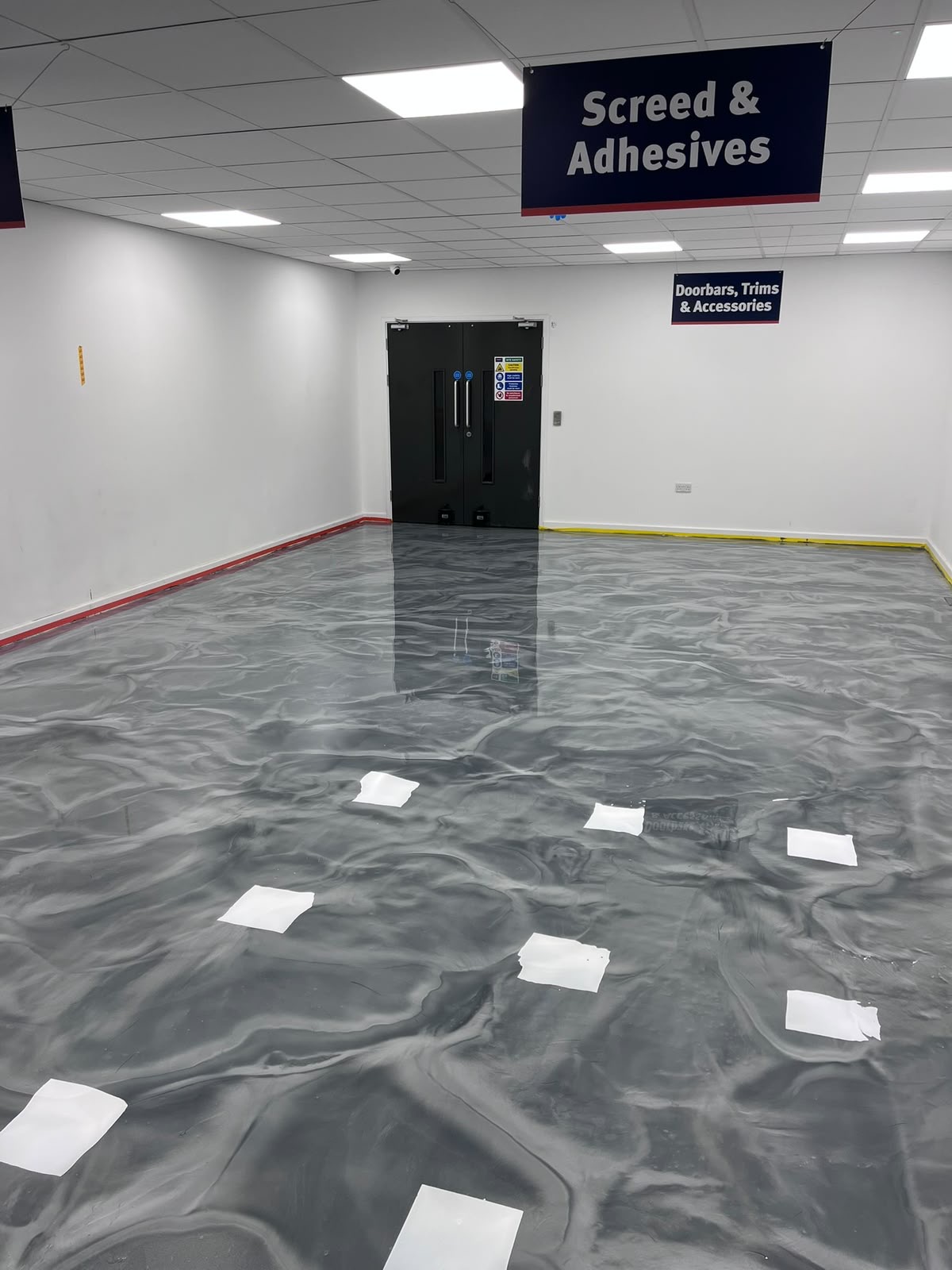
Built for the way you actually use the space.
Warehouse floors take a beating. Our systems are built for racking loads, MHE traffic and 24/7 operation, with crisp aisle markings and slip-rated zones. Installed in phases so your operation keeps moving.
Heavy-duty flooring systems for high traffic and continuous industrial use.
Warehouse floors take more punishment than most people credit. Racking point loads, VNA truck traffic, pallet drops, changing temperatures, wheel scrub in the pick faces. A floor specified for anything less than the real duty will fail early. Our warehouse builds are designed against the actual operation.
We install warehouse resin flooring across the West Midlands for logistics, 3PL, distribution and manufacturing clients. Every install is designed around the MHE list, racking layout and operational hours, and phased to keep the site trading throughout.
For damaged concrete, our guide to warehouse floor repairs before resin flooring explains how cracks, old coatings and contamination are assessed during preparation.
Planning around operations? Our guide to how long commercial resin flooring takes explains preparation, curing, phased installation and downtime planning for warehouses and factories.
Much of this work sits in and around the West Midlands conurbation — see what we install across Birmingham and the surrounding areas.
Key benefits
- Rated for counterbalance, reach and VNA truck traffic
- Aisle marking, hatching and pick-face demarcation
- Anti-slip zones for ramps, wet areas and pick faces
- Phased installation to maintain operational uptime
- Dust-free surface — reduces palletised product contamination
- Long service life with straightforward re-coat cycle
Our installation process
Every warehouse flooring project follows the same disciplined sequence. Skipping steps is where floors fail — we don't skip.
- Step 01
Survey and duty specification
We survey the site, review your racking drawings and MHE list (counterbalance / reach / VNA / EPT), and specify a build-up sized for your point loads and traffic pattern.
- Step 02
Preparation
Diamond grinding or captive shot-blasting to the CSP profile the system requires. Existing coatings are removed rather than coated over.
- Step 03
Slab repair
Cracks, spalls, joints and any historic damage are cut out and re-mortared. Movement joints are honoured or bridged based on their function.
- Step 04
Primer and body coat
Penetrating epoxy primer followed by a pigmented body coat — either self-smoothing for pick faces or broadcast for high-abrasion aisles.
- Step 05
Line marking
Full aisle, hatching, pick-face and safety line marking is set out to your layout drawings and coated in a contrasting resin — not painted on afterwards, so it lasts the life of the floor.
- Step 06
Chemical-resistant top coat
A clear or pigmented PU seal locks in the aggregate and delivers the specified slip rating. In heavy-traffic aisles we typically specify an aliphatic PU for maximum abrasion resistance.
- Step 07
Phased handover
We hand each phase back to operations as it cures, with clear signage on the traffic-return times, so warehouse flow is preserved throughout.
Where it works, where it doesn't
We're honest about specification. A system installed in the wrong environment will fail no matter how well it's laid.
Suitable for
- Distribution centres and 3PL operations
- Manufacturing warehouses and stockyards
- Cold and chilled storage (with PU screed)
- E-commerce fulfilment centres
- Racking installations and mezzanine floors
Not suitable for
- External yards without a suitable protective overlay
- Substrates with rising damp and no DPM (requires remediation)
- Timber decks without a rigid overlay
Advantages and trade-offs
Advantages
- Purpose-designed around your operation
- Line marking that lasts the life of the floor
- Phased installation preserves throughput
- Reduces MHE wear and dust generation
- Long life with a simple re-coat cycle
Trade-offs
- •Areas under coating are offline while the system cures — cure and return-to-service times vary by system and site conditions
- •Full chemical cure time before heaviest loading depends on the system and site conditions
- •Existing badly worn slabs need remedial work first
Durability and lifespan
A properly-specified warehouse floor wears in a predictable pattern: the traffic aisles ask for a top-coat refresh long before racking bays and slower-traffic zones show anything at all. That gives clean planning windows for refresh work. Service life itself varies with the system, substrate, environment, MHE loading, use and cleaning.
Line marking specified as part of the resin build (rather than painted afterwards) lasts the life of the floor. That eliminates the ongoing cost of re-painting aisle lines over time — a hidden operational saving that quickly recovers the up-front cost.
Curing times
Cure and return-to-service times vary by system and site conditions. Colder conditions extend them; warmer conditions shorten them.
| Stage | Time | Notes |
|---|---|---|
| Foot traffic | Varies by system and site conditions | Light walking in socks or clean shoes once the top coat has gelled. |
| Furniture return | Varies by system and site conditions | Light furniture, tools and shelving can be reintroduced. |
| Vehicle traffic | Varies by system and site conditions | Hot tyres and heavier point loads once the PU seal has fully cross-linked. |
| Full chemical cure | Per manufacturer technical guidance | Chemical resistance, wet cleaning and heavy wear reach design spec. |
Maintenance and aftercare
Warehouse floors want daily sweeping (or ride-on scrubbing) to lift grit before it abrades the top coat. Weekly rotary scrub with a neutral pH detergent keeps the sheen and the slip rating consistent.
We recommend regular professional inspection, with a top-coat refresh in the busiest aisles when inspection and wear indicate one is required. This resets the sacrificial wear layer at a fraction of the replacement cost.
Aftercare checklist
- Daily sweep or scrub across all aisles
- Neutral pH detergent only
- Repair any damaged wheels or MHE promptly (metal wheels destroy resin)
- Periodic professional inspection
- Traffic-aisle top-coat refresh when wear indicates it
Colour, finish and customisation
Colour zoning is where warehouse resin genuinely pays back — different colours for pick, pack, dispatch and QA zones, contrasting hatched pedestrian walkways, and safety-yellow racking bases. All of it is specified into the build so it lasts the life of the floor.
Where required we can also integrate anti-static coatings, chemical-resistant tanking around bunded areas, and drainage-fall correction as part of the same installation programme.
Available finishes
- ◆Full colour zoning by operational area
- ◆Aisle, hatching and pedestrian walkway marking
- ◆Slip-rated finishes by zone
- ◆Anti-static system for electronics DCs
- ◆Bunded and tanked chemical storage zones
- ◆Cold-store rated PU screed
Send us your racking drawings and MHE list — we'll come back with a specification and a phased programme.
Warehouse Flooring — frequently asked
Can you install while we're operating?+
For suitable projects, installation may be planned in phases to help businesses manage operational disruption. Where a project has specific shutdown or access requirements, these can be discussed during project planning, including whether alternative working arrangements are practical.
Will the line marking last?+
Yes. Because the marking is installed inside the resin system rather than painted on top, it lasts the life of the floor. There are no annual re-marking costs.
What MHE can the floor take?+
Standard builds carry counterbalance forklifts and reach trucks. VNA operations, ride-on scrubbers and heavier point loads get thicker builds specified against your actual MHE.
How disruptive is the installation?+
Each phase is offline to foot traffic briefly, and longer before heaviest loading. Phased programmes usually mean the wider site stays operational throughout.
How long before we can put racking back?+
Timing depends on the specified system and cure conditions. We plan the phasing around your rack-out sequence.
Related resin systems
Industrial Flooring
Heavy-duty resin systems built for industrial use.
ReadPU Flooring Systems
Polyurethane systems for the most demanding environments.
ReadCommercial Flooring
Seamless resin floors for offices, retail and hospitality.
ReadAvailable across the West Midlands
We install warehouse flooring across:
Call 07756 971 165 for a free quotation, or email admin@epoxyguys.co.uk.
More resin systems by Epoxy Guys

18 sectors. One specialist team.
Warehouse, factory, food, healthcare, retail, showroom and more — engineered resin systems delivered around your shutdown windows.
Ready to start your project?
Call for a free quote, or send your project details by email and we aim to respond within one working day.